Showing posts with label travel. Show all posts

Monday, November 14, 2011

Two Roads Diverged in a Wood: A Rough Guide to Skyrim

The Elder Scrolls V: Skyrim is a game about travel. At first glance it might appear to be a game about claiming your mytho-genetic heritage, or slaying dragons, or playing errand boy to a staggeringly diverse range of characters who can't be bothered to shift themselves 50 feet from the pub to drop off a satchel of supplies.

There's a strong argument to be made that Skyrim is really about progression: about using and reusing your skills, from cooking to conjuring, until you become a Michelin-star worthy sorcerer-chef who wields fireballs and cookpots with equal dexterity. Indeed, you'll spend a lot of time in Skyrim - most of it, I'd wager - leveling up your character, chopping up bandits and skeletons and packs of walruses (yes, really), and then dutifully returning to town with your spoils. These might take the form of battered and rusted helms, great slabs of meat and ivory or enchanted staves and dragon scales.

A game about traveling...without Goretex.
 All very true.

More than anything, though, what you'll find yourself doing is traveling. All those dungeons, hunting grounds and markets are separated by one of the most vast, changeable and treacherous environments ever created for a videogame.

Skyrim is just the latest in the Elder Scrolls series of games. These have always taken openness and player choice within a vast landscape as their core design directives. In fact, the worlds of the latter three games - Morrowind, Oblivion and now Skyrim - are exponentially smaller than those of the early Daggerfall game, which boasted 487,000 (procedurally-generated) kilometers of terrain with 3/4 of a million characters and 15,000 locations.
Sure, it's ugly...but there's a lot of it.
Skyrim, by contrast, boasts just 41 square kilometers of terrain. But what a terrain it is...
We'll no longer burn to be brothers in arms.
Loping through these fog-shrouded forests and clambering over the rocky cliffs, I was tempted to play Dire Straits Brothers in Arms (these mist-covered mountains...) but the dynamic music that cues changing weather, nightfall, the presence of enemies and the passage of time remained too engrossing.

This is becoming a sloppy paen to the merits of Skyrim's world, but there's a decent reason for that. It's a deeply flawed piece in a few key ways, but it's one of a small handful of games that actually caused me to stop, gasp and stare at...nothing. Well, not nothing, but something that wasn't a pre-rendered action sequence or bad-ass triple kill.

In this particular case, I emerged from the ruins of an ancient temple, having battled a handful of bandits, a few reanimated corpses, an ancient, axe-wielding lich king and some highly unpleasant spiders. I'd learned a new epic Shout (a kind of primeval draconic magic spell) and found myself laden down with goods for sale. When I stepped out of the cave (waiting the requisite 15-30 seconds for the game to re-render the world (you can walk from coast to coast without a single pause but for some reason, the smallest hovel requires a loading screen)) and stopped dead. I actually called my wife over to see the screen.

Night had fallen on the alpine mountainside that I stood on, along with a light dusting of snow. The pine trees creaked in an eerie wind, lit by a massive, pale moon. From horizon to horizon, an aurora (may as well call it the Aurora Borealis) blazed across the starry sky, in sheets of curving, shifting color.

Look upon Bethesda's works, Sir Edmund Hilary, and despair.
 I knew that computers can easily render an aurora (there's even a screensaver). I also knew I was staring at a cheap virtual representation of a real-world wonder. But in that exact moment of gaming, I recalled why I love the damn things so much. At their best, they transport us to another world and suck us in so deeply we dream of them.

As worlds go, Skyrim is one of the very finest.

One more anecdote. Last night, I set out (on the advice of several townsfolk and a sneering castle mage) to find the magical College of Winterhold, set in the far, far north of this icy land. I'd only explored a small area around the central province, but I set off north, following the stony road.

Moments before a dragon landed on her head.
Immediately, I encountered an obstacle. While hunting an elk that wandered across my path, I stumbled into a nest of bandits working an old mine. My compatriot (a temperamental warrior-maid who consented to follow me after a brief bar brawl) and I made short work of the compound's guards, but in the depths of the mine she fell in battle while I barely held on to my life.

Though I regretted her fall, as she'd helped me slay my first dragon, I gathered up as much iron and treasure as I could and immediately hiked back to Whiterun to sell and buy supplies. Because there was too much to carry, I was forced to make a second trip to the mine...where I was immediately set upon by a wandering dragon. Again I had to retreat after mounting a brief and futile defence. Forced back down the hills in the dark of night, my archer-mage dodged blasts of ice and cast spells over her shoulder. Luring the beast towards the city guards, I turned and fought, slaying that dragon too and retiring afterwards to rest until (virtual) morning.

Pro-tip - you will never, ever, ever catch that deer.
Slightly richer but worse for the wear, I set out again for Winterhold (on a regular day's commute, the greatest setback is usually forgetting my keys). I made it further this time, before another ill-advised chase after wild deer put me off the trail. Trying to get my bearings, I hiked to the top of the highest mountain I could find, where I came across a stony shrine to some unnamed, long-dead Nord warrior, ringed about with valuable artifacts and golden offerings. 

Well, a little grave-robbing never hurt anyone...

I got away with that, then took my bearings from the peak and set off for the nearest city. The trip down the mountain was relatively uneventful - which is to say, I discovered an ancient locked cliffside temple, killed a pack of wolves, fought and defeated some kind of archaeologist-bandit and read her notes for later investigation, and got ambushed by a pack of horrible, venom-spitting spiders.

When I finally arrived at the city I'd set out for, I found that it wasn't Winterhold, but Dawnstar, another Northern city with a small port and an active mine. There's plenty to do in Dawnstar, but the journey was taking longer than expected, so after some quick trading and a night's sleep, I set off north and east. 

Following the shoreline, my aspiring mage was once again sidetracked. First I had to fight off a pack of Ice Wolves, bigger and nastier than their southern cousins.

I also had to detour around some giants, who didn't attack immediately but looked more than a match for me with their giant clubs and herds of mammoths.

Objects in the mirror may be larger than they appear.
When I made it past the wolves and the giants, I saw a vast temple rising out of the ice on the very northern shore of the content. This, I thought, must surely be the College of Winterhold (Skyrim has a map but its sense of distances is, as befits a faux-medieval parchment, somewhat distorted).

I made my way across the ice floes only to find another wind-wracked ruin. I'd gone too far north, and had to follow the rocky cliffs, hopping between ice, sea and little outcroppings of beach. I was nearly back onto a road before a pack of slow-moving but nasty walruses lumbered up on me, forcing me to spend two dozen arrows against their leathery hides.

The map told me I was close, but I wasn't sure how to get to Winterhold. A guiding enchantment took me along the rugged coast, looking for a way up the sheer cliffs. A blizzard blew in, obscuring the sky in great sheets of white snow. 

When I finally saw the damn place, Skyrim stunned me all over again. A massive castle perched on a spindly rock spire, with a filament-like bridge arcing between the mainland and the College. It was literally hundreds of feet above me, partially obscured by snow. As it turned out, I had to hike around the rest of the point, climb another mountain and follow another road to reach the town - and I won't spoil what happens next.

What I realized then is that I'd raided a mine, fought a dragon, hunted elk and wolves, battled giant spiders, mined, traded, cooked, slept and smithed across perhaps 10 miles of virtual terrain - and I hadn't even done it for a game-assigned quest. I was quite literally just trying to get from point A to point B, a journey that took my character across one small sliver of the country's north-eastern quadrant.

In spirit, Skyrim is perhaps most similar to Rockstar's last open-world opus, Red Dead Redemption.
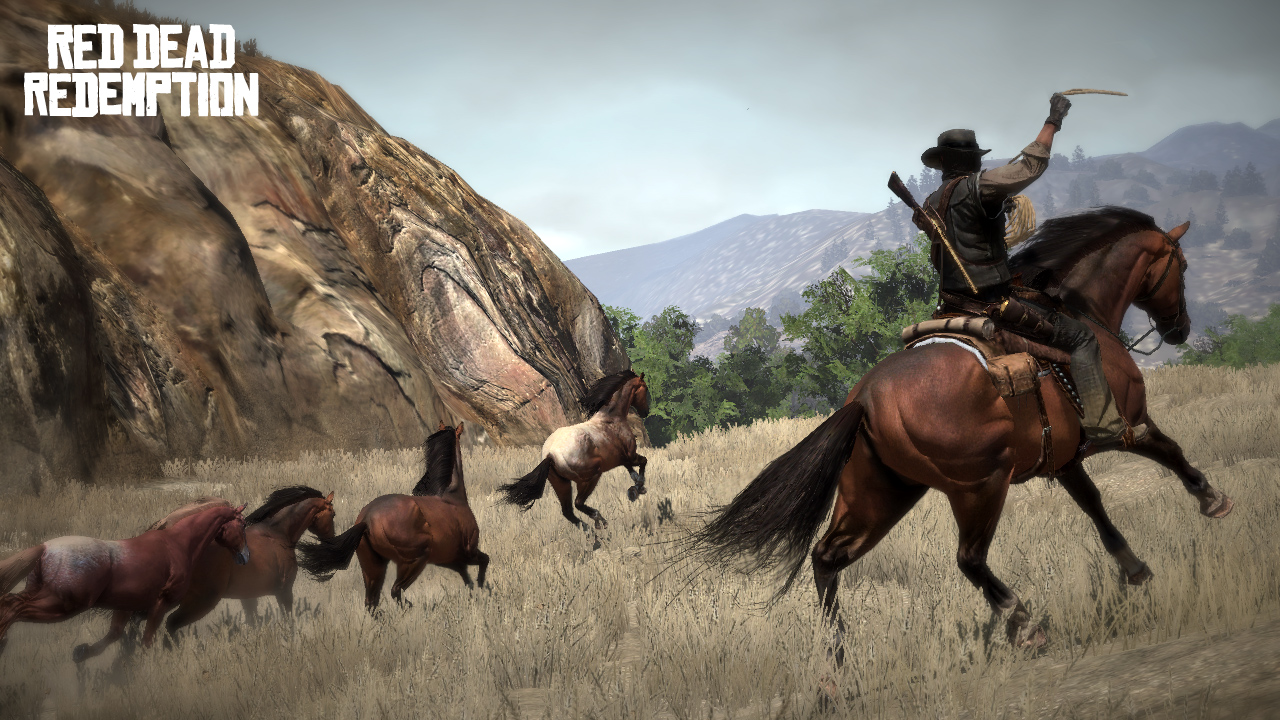
Literally the saddest thing in RDR: the first time your horse died.
 That game, too, won many of its best moments not through heavy scripting or fetch quests or canned dialogue, but through the sense of wonder inspired by the scale and richness of its game world. Yes, you do eventually realize you're walking through a series of random-yet-not encounters, whether it's a pack of wolves hunting a deer or an assassin's ambush. But if the world feels right enough, and the ambience is polished enough, you don't really care. 

Getting places isn't really an adventure for most of us in the video-game-playing first world anymore. The triumph of Skyrim is that it makes you feel brave and adventurous and skilled...just for walking around.

I'm a rolling stone...
More later.

Saturday, June 2, 2007

Rule Brittania

Been in England for about 2 1/2 days now...what an incredible change. From the bustling, crowded, hot, dusty, vibrant, chaotic, overflowing streets of Cairo to the cool, shaded, verdant lanes of Oxford town and university. The first day I was here it was almost as if I had died and gone to heaven, coming from the sprawling desert heat into rolling fields, parks, grand stone buildings and overgrown gardens. Instead of diesel fuel I smelled flowers and growing things; instead of car horns I heard birds.

Oxford is really everything I imagined England to be, which makes sense - so many of the classic English writers were educated here. It's almost a fantasy of a town, and I could just get lost in the arches and vaults of the University for days or weeks or years. Cairo was the sort of place where everytime you turned a corner, you saw something that was bizarre or fascinating or ancient. Oxford is sort of the same way, but in a welcoming, comforting sense.

It's also funny because looking at England you kind of figure out how Boston came to look and feel the way it does. Obviously, that's simplifying, but the similarities in England and New England architecture, landscape, and layout are striking. I feel like I am in a reflection of home sometimes - or that home is a reflection of here.

Wednesday, May 30, 2007

Homeward Bound

Well, my last day in Cairo is slowly coming to a close. I rose early this morning to go to Giza to do a bit of riding - and to see the Pyramids, which I have so far failed to do! I walked out the dorms to get a bit of extra cash, but the ATM at the supermarket was closed. Then I walked to the next corner, where there's normally another machine - and it was gone. Simply vanished. Bizarre. So I walked to the post office, but that one wasn't accepting my card. On to the Faisal Islamic Bank's machine, but it was out of order. 25 minutes and 4 machines later, I finally managed to withdraw from the Egypt National Bank on 26 July.

I headed back to MG Stables where Thalia and I rode last time - if any of you are in Cairo, I heartily recommend it, it's a good, respectable place and everybody knows it. Ask for Mohammed Ghoneim, the owner, and Nasser, the guide. Nasser took me out and gave me a bit of tutorial riding in the desert, trying to smooth out my trot and keep the horse under control in a gallop, then we infiltrated the pyramids. We rode out to a section of wall with a little Bedouin hut next to it, and bribed the Bedouin to open up the fence and let us in. Then we rode through the dunes surrounding the Pyramids, around 8 in the morning, and got to see them up close, in all their glory, without a single tourist around. It was really amazing, to be there with nothing but a few stray Bedouin hanging around, instead of massive tour groups. The light wasn't great, but hey...what can you do?

There was a desert boy there with a camel, and I rode that just for kicks. Camels officially suck, they're the dumbest animals I've ever seen. Mine walked about 10 metres, came back, and then made a sound like a diesel engine trying to start with severe flatulence and refused to sit down so I could get off. It took Nasser and the boy to drag the stupid thing down. I hate camels. Horses are much better.

We returned, I said my farewells, then walked back to the main street where, not wanting to pay a further 30LE to get to Zamalek, I took a baffling series of buses and minbuses until I got to the train station, then the Metro back to Zamalek. Of course, the train drops you at the far end of the island from the University dorms, so I got to walk most of the length of it, shooting pictures as I went. It was a nice morning, so it was all good, and I got back at 10:30 or 11 - just as Joe was getting up!

It was really cool to get out there in the desert, with no one around, no one at the Pyramids, just me and the sky and the desert. I love riding, and riding in the desert - total freedom, total emptiness, and a real touching loneliness. I feel compelled to come back to Egypt, a country full of contradictions and bizarre sights. The cabdrivers try to rob you blind, but when I was trying to figure out the bus system, on three occasions different men flagged down the buses for me and explained to the drivers where I was going because I didn't understand the geography or which bus to take. It was a really kind gesture of them.

I'm going to miss a lot of things about this - the dirt and the irregular facilities not among them. But speaking Arabic everyday, the people, the crazy crowded rhythms, the surprises around every corner, cheap coffee, fancy restaurants. Even the slowly pulsing Nile, which I was so disappointed with at first, has grown on me and become a kind of constant navigational companion.

Tomorrow I have to get up a bit past dawn to get my flight. Tonight is my last night in Cairo. Half-sad, half-happy - I'm looking forward to going home. We'll see how I like it there.

Wednesday, May 16, 2007

Odds and Ends

Sometimes it's the small things in life that are most peculiar. For instance, yesterday I walked out the door of the dorms into a billowing cloud of white smoke that obscured the sun and rendered the church spire across the street as a ghostly silhouette. It was strange and surreal, made more so by the fact that no one seemed to notice or indeed care. Normally when there's smoke everywhere people are at the very least curious. Apparently not in Cairo, where the catastrophic is more or less the everyday. But the oddest bit was that there was no smell of smoke or fire, as one might expect.

After the shuttle left, we found the source of all the smoke - a battered old Toyota pick-up that was spewing it everywhere out of something in the bed of the truck. It was really disconcerting, as the thick white fog totally enveloped the bus and made it impossible to see. With the early-morning light filtering down through the trees and the crumbling balconies of Zamalek, it looked like the beginning of a war movie. At one moment, I was kicking myself for not having a camera - there was a soldier pacing by his post, head bent, underneath a spreading tree in front of a little mosque, with the sun-beams refracting through the air and only the silhouette of the soldier and his gun visible. It was a beautiful sight, in a strange way, and I wish I could have captured it.

The other oddity this week is that less than 10 days from our final, our Fusha Arabic teacher injured herself on some steps and can't come in for class. So we got a substitute today, to teach until the end of the semester. Now, our original teacher was a very nice, affable, likeable lady, but while she was very good at Arabic, she didn't make too much effort to keep the class talking in Arabic the whole time. I didn't really realize until this sub showed up today and said maybe 3 English words during the whole 3-hour class. He really kept on us, never gave instructions in English - if we had had him for the whole semester, I might have learned a great deal more Arabic. Still, I find that I can roughly follow Al-Jazeera broadcasts and regualr newspaper articles, so I can't regret it too much.

Only 1 week of school to go. It's too bizarre for words - I remember distinctly arriving in Cairo, when Joe and I were baffled by the 15-second shuttle ride that was required to take us from the airplane to the gate. It's kind of a theme in Egypt - lots of effort and trouble and hassle to save a tiny bit of work. Once we got to the gate we were released to the mercy of the arcane mysteries of Passport Control, a system that would give a Byzantine bureaucrat solid cause to just off himself. Fortunately, there was a sort of pool shark of the airport there, waiting for a different group of AUC students. He was dressed in a glossy pinstripe suit and shoes so pointy you could use them like a drill. But he whisked us through, running around, waving and nodding at airport personnel and generally marshalling us through the ineffable chaos.

The real Cairo shock set in once we got out of the airport proper and found ourselves at the mercy of a pack of ravenous porters and taxi-drivers. They all but pried our luggage from our hands, and after trying to forcibly load it - and us - into a variety of increasingly alarming transports, our AUC escort showed up with a car that can only be described as appalling. Taxis are not normally the most well-maintained of vehicles, but it's really pushing the issue to have a car that does not, in fact, possess a dash-board, but rather a crumpled plastic shell covered in open wiring, topped with a fuzzy purple leopard-print rug and a box of tissues blinged-out like the cover of a Chamillionaire album.

And of course the driving was terrifying - roads no wider than Memorial drive transformed into six-lane free-for-alls. I'm convinced that no one has actually explained the concept of lane-dividers to the Egyptians...it's the only conceivable reason for the way they try to fit three or four or five vehicles into a space meant for two, passing on the right, the left, from behind. If there were a way to physically vault your car over the one in front of you like some half-ton game of hopscotch, the Egyptians would do it.

I'm going to miss this place.

Saturday, May 5, 2007

Return from the Hidden City

Last time I told you about how getting to Petra, and everything we did there. But getting back was an adventure in and of itself. Also, this has been one of the most boring weeks ever, so I'm working the Petra story for all it's worth until something else exciting happens.

We set out from Wadi Musa to Aqaba fairly early, wanting to get the 12:00 fast ferry back to Egypt. Since there were no minibuses or public transportation, we were forced to use the hostel's pickup truck, at pricy $40 for a 2-hour ride. But it was a lot of fun driving through the Jordanian landscape, and it really had me very thoughtful and pensive the whole way. I wasn't able to get many good pictures because of how fast we were driving, but the landscape is very desolately beautiful - rolling dry plains and rocky mountains, extending onwards and onwards under a massive blue sky. Joe reminded me of a very perceptive quote - a historian who said that it was no wonder monotheism came from this land with nothing in it but hills and rocks and sky. In the fertile valleys of Egypt, Greece, Mesopotamia, Rome, and Mesoamerica, the people could make gods for everything - trees, rivers, sun, earth, animals, the sea, and so on. But herding sheep in the dry hills of the Levant, there's not much to worship aside from the sky.

And it really hasn't changed that much...we drove for an hour without seeing much more than hut-like homes and black Bedouin tents with their herds. The same sense of wide-open wilderness still prevails in many places. It's a land that makes you feel very small and alone, out beneath that immense sky.

But that ended as we drove through the desert valley leading into Aqaba, finally culminating in the sprawling, modern port city. A massive Jordanian flag easily 50m across waved lazily in the breeze. We got to the ferry-port - and there were no spaces left on the fast boat. This condemned us to the "slow boat", a conventional ferry that departed at 3 - nominally - and took 3 hours instead of 1. So standing around the port at 10 in the morning, we prepared to wait.

And wait.

All told, we were there for 7 hours before departing. We sat in the cafeteria, hid from the sweltering sun and heat, and tried to pass the time, reading all the books we had, writing in journals, talking, drinking coffee, and staring off into space. There were really two ways it could go: sit there in utter misery at our predicament, or laugh it off as one more ridiculous 3rd-world transit adventure. Fortunately, we chose the Douglas Adams-esque latter option, and ended up having a pretty good time just laughing and chatting. Never underestimate the presence of a good travelling companion - without Joe to converse with, I would have gone totally bat-shit.

And speaking of Adams - although he said "always know where your towel is," in the middle east I think that gets translated to "always know where your kaffiyeh is." I've heard the epithet "towel-head" used for Arabs and now, frankly, I don't think it's insulting at all! A kaffiyeh is the world's most useful garment. Wrap it around your head to keep the sun or the rain off, around your shoulders as a shawl for the sun, around your face in a dust storm, use it as a towel after washing, pile it beneath your head as a pillow, put it over your eyes to help you sleep, and of course it's always a stylish scarf. I used it for all these things in the course of 2 days - it's my new favorite item of clothing. It would seem Adams knew what he was talking about!

Anyways, we also spent part of the time at the ferry part talking to two travelling companions, a Saudi entrepreneur and a taciturn Japanese retired engineer. They fulfilled their stereotypes perfectly - the Japanese man was a prolific traveller, very polite, with limited English, and when I mentioned Boston he got really excited about Matsuzaka. The Saudi was a loud, arrogant man in a brilliant white robe and mirror shades, who talked incessantly about money and the correctness of Islam, and used one of his two camera-phones to show us pictures of his horse, his motorcycle, his farm, his daughter, his car, etc., etc. Yes, he really just mixed his daughter in with all his other possessions. As a sociological sample, he was interesting, but as a person he was dreadful...I can only hope all Saudis are not like that. He also had a weird way of shifting from telling dirty jokes and making crass comments about women to talking about how shameful the way Western women dress is and how terrible alcohol is.

We boarded the boat around 4, and spent another hour and a half waiting for it to leave while they loaded trucks, cars, and so on. I tried and failed to take a nap, so I spent the time just conversing with Joe. Our conversation lasted almost two hours, so we were well on the way by the time it ended. We decided to get dinner, a not entirely dismal affair, and then were ambushed by the Saudi guy again. We went to the top deck to chat, and when I got sick of him, I went down to a lower deck to nap, which lasted until our arrival.

But a bizarre thing happened on our arrival - we were on the upper uncovered decks, enjoying the fresh air, and they locked the doors. Every single door leading down into the ship was chained shut. Though probably just for crowd control, it was very disconcerting, and we joined a couple of sheikhs in yelling at the officers until they let us out. Sometimes being an ajnabi, foreigner, really helps. We finally shuffled out through the car deck, almost unbreathably inundated with diesel fumes, and slid through customs in tenth of the time it took back in Jordan.

It was now about 9:30 or 10 at night, but fortunately there was a night bus to Cairo. While waiting for tickets, we met two travelling Libyan entertainers - one was a singer, the other an actor. They were really fun and funny guys, who spoke very clear Arabic. One of them was even diabetic, and we commiserated about that. As Arabs often do, they bought us water and food without even asking, and we passed the time chatting to them until the bus left. It was a welcome change from the Saudi bore.

The ride itself was weird, but not bad. My seat "broke" - which meant it reclined 90% into an almost perfect bed on which I slept for about seven of the ten hours. Unlike the journey to Nuweiba, which had shown an ancient C-quality Sinbad movie and The Man in the Iron Mask, the movies on the inbound bus were bizarre Arabic drama/comedies with lots of yelling. I put in my earbud headphones, wrapped my kaffiyeh around my head, and slept.

I woke in Cairo, feeling cheerful and rested, and though we had to argue at the bus station taxi drivers about prices, we eventually beat it down from 50 pounds to 20. The taxi driver even brought me a glass of tea, which was pretty difficult to drink as he careened through the streets. But my lightning reflexes kept me from spilling any, and we arrived in good enough spirits to not collapse for the whole day.

Wednesday, May 2, 2007

Voyage to the Hidden City, Pt. 2

Sorry I've been gone for so long - I try to put something down every two days, but the past week has been crazy. Anyways, last I wrote we had just got to the town of Wadi Musa, which occupies the valley outside Petra.

Our first decision was also our best one - Joe and I decided to get up and over to Petra as early as possible, and we arrived about half an hour after it opened, at 7:30. There was still a greyish early-morning glow and as we walked down the road to the entrance of the Bab Al-Siq(literally Door of the Shaft), the Bedouin were just bringing out their horses so they could try to get tourists to ride them. But we passed on that and headed into the narrow valley that leads into Petra. The Siq is a narrow, winding passage of crimson sandstone warped into bizarre whorls by some ancient stream.

We walked down, taking pictures, and the walls of the canyon began to close in. Then, after at least a kilometer, we saw a crack of light. As we approached, we saw the classic shot that any photo-series on Petra has - the facade of the Treasury gleaming in the sun as we walked down the path. You know, the Indiana Jones thing. But it comes at you as a surprise, and it really is breathtaking.

We admired it for a while, having the place almost to ourselves aside from a few camel, two tourists and some Bedouin. It was really amazing - the peace and quiet, the solitude all contributed to the majesty of the sight. It wasn't nearly the same at the end of the day when it was swarmed with people - much less stirring. Anyways, we moved on - we were planning to do the Lonely Planet guide's two-day itinerary in about eight hours.

We walked down the valley, passing more tombs and carvings on either side. There are almost no buildings as such in Petra - just magnificent Classical Greek-style facades that the Nabateans carved for their tombs, store-rooms and palaces. They actually lived in tents, and I can't blame them - I wouldn't want to live in those artificial caves. The more I thought about it, the more I realized things haven't changed that much in 2000 years. There are still Bedouin with their camels and goats, still open-air markets in the middle of the city, still people coming from a long way to see the tombs and temples.

We passed the Ampitheatre and the Tombs of the Kings, all of which were almost entirely abandoned. There were a few other people walking around taking pictures, and lots of goats. Then we set off down the old Roman rode that runs down to the only free-standing structure in the area, the Qasr al-Bint: literally, Palace of the Girl. I have no idea why. Really, it's not all that impressive -although from an engineering standpoint, it's more difficult, the cliff-side facades just look so much cooler. And over time, the soft sandstone from which they were built has slowly eroded, leaving them with a weirdly melted look.

After a quick stop in the Nabatean Museum, we set off down the Wadi al-Deir, the long canyon at the end of the Petra valley. At the entrance to it their was a sign warning "Danger! Do Not Go Beyond This Point Without A Guide", in English. We were skeptical, and looking around, we didn't see any guides! So off we went. The climb was really nice, winding up through the sandstone valley, with a little side hike to a hidden, forested glade with the "Lion Tomb." We wound up further and further, catching glimpses of stunning vistas and marvelous sandstone formations, and making more than a few wrong turns. I guess if we had been blind and stupid, we might have been in some danger - there were a couple of paths that dead-ended into sheer drops. But it was no more perilous than your average hike.

Finally, we saw the summit of the climb in sight, with a tent set up to serve tea, coffee and hookah. It looked interesting, but not all that great - the view had been better further down. A British guy who had climbed the last five minutes with us quipped "I've half a mind to write to Lonely Planet about this."

Then we turned the corner. And there it was, "The Monastery", another facade easily the equal of "The Treasury"(both those names are misleading, they are neither!), but with a much more commanding view. We rested at the summit for a while, snacking on bread and peanut butter(a cheap traveler's best friend!) As we headed back down we ran into two of our travelling companions sipping tea and shisha, and talked to them for a little while. Their plan was even more ambitious than ours to go overland to Amman and then Damascus!

As we descended, we began to see more and more tourists. Then the donkeys laden with overweight Latino tourists - as well as other AUC students(not overweight, though) - started passing us, hogging the whole narrow stone path. By the time we got the bottom, the Wadi was flooded with tourists heading up to the site that we had enjoyed in relative peace and solitude. And of course, there were "guides" and touts offering to lead people up what was essentially a totally linear hike now filled with people going both ways, and offering the "official" warning sign as evidence of the danger!

We made our way against the stream and then headed for our final destination, the High Place of Sacrifice. This was essentially a cliff in the middle of the Petra valley with a long, long series of steps leading up to it. We made our way up, the sun now blazing down on us, and probably drank a good .75 litres of water apiece making it to the top. By the time we got there, 45 minutes of stair-climbing later, we were pretty beat, so we decided to make the High Place of Sacrifice the High Place of Lunch. Yeah, you guessed it - pita and peanut butter! And the best part - we'd done the Lonely Planet's two-day itinerary before lunch.

The view of Petra was pretty spectacular, but unfortunately the haze made it a lot less photo-genic than it could have been. I guess the valley kind of traps the hazy moisture. Finishing our lunch and finding ourselves surrounded by Russian tourists, we made our way down the other side of the cliff through another little valley with smaller, more finely-carved tombs and relics, including the house of the man who controlled the water cistern for pilgrims on the pilgrimage route.

Reaching the bottom, we had walked over 12 miles. We had to plow our way through tour groups to get out, and some Arab film company was even setting up a film shoot in front of the Treasury facade! It was utter madness getting out, and then we had to walk another mile to the town center to get money from the ATM. The fudgesicle thing I had on the way up was the best food I have ever tasted!!

We were so tired, the evening was pretty low-key: nap, wake up, eat dinner, have drinks in a 2000-year-old Nabatean cave tomb, a bit of al-Jazeera and then bed.

Saturday, April 28, 2007

Voyage to the Hidden City, Pt. 1

My adventures for this weekend revolved around visiting Petra. Strictly speaking, however, most of my time was spent in transit - an experience, I can assure you, was a bit less than exemplary. As a study in how the Middle East basically seems to work, however, it was pretty invaluable. So I'm going to drag you through every excruciating moment of it. I will, however, refrain from using the phrase "Rose Red City," throughout, because I'm thoroughly sick of that epithet.

We set out from Cairo late Tuesday night to take a bus to Nuweiba, a little port city on the Red Sea in the Sinai Peninsula. The plan was to take a ferry from Nuweiba to the Jordanian port of Aqaba and from there another bus to Petra, about two hours inland. There's another way to get there, by cutting through Taba in Egpyt and Eilat in Israel, but that involves getting an Israeli stamp on your passport, which is the kiss of death for trying to enter any Arab nation except for Egypt and Jordan.

Little did we know that Nuweiba is pretty much the sphincter of Egypt. It wasn't quite a wretched hive of scum and villainy, but it was pretty damn close. Apparently the tourist part of the town is actually quite nice, but the port authority area is a sprawling mess of dirty cafes, loading docks, shipping offices, and filth. This place was seriously disgusting even by lax Egyptian standards. We spent most of our time in the shaded courtyard of the ticket office, which was the least awful of the available locations.

Don't even get me started on the cement-block hole-in-the-ground Egyptian squat toilets. The most foul truck-stop restroom in America wouldn't even be able to hold a candle to these - in fact, if they did there might be some sort of explosion. I will never be able to understand how an Islamic culture which places such a high value on personal cleanliness and regular ablutions allows its streets and especially its washrooms to become such vile cesspits.

The bus which we had taken was actually chock-full of AUC students, but most of them were going to Israel, so they got off in Taba to head north to Jerusalem. There were a couple of others with is in Nuweiba, including two crazy guys who planned to visit Petra, Amman, and Damascus all in one weekend. And even though it often takes 8+ hours to cross the Syrian border - if you get across at all - they still probably spent less time in transit then us.

Joe and Ben - another guy visiting Jordan - and I chilled in the ticket office until they finally decided to start boarding the "fast ferry." After being shuffled through six or seven different waiting areas, having our passports and tickets checked innumerable times, and being put on buses that sat idling for 10 minutes to travel no more than 500 ft. from the terminal to the boat, we finally boarded the ship - only to have our passports confiscated for "processing."

Now, being out of control of your passport is a worrying state of affairs at the best of times. Giving it over to the grimy hands of the Jordanian/Egyptian state port security services would be enough to give the Dalai Lama an aneurysm. But, we bore it with admirable patience, and after finally shuffling everyone around, the boat took off from the dock. And it was a fast boat - the "slow ferry" was still boarding trucks when we arrived in Aqaba an hour later, around 6pm. We were optimistic that we would be in Petra by 8, and happy that our investment in the "Fast Boat", about twice as expensive as the regular ferry had paid off. So we pulled into port...and waited.

And waited.

And waited some more. We sat in our seats, with no one telling us a bloody thing about what was going on. A few other foreign nationals were let out but they weren't letting Americans anywhere. Mind you, they still had our passports during this whole ordeal. Finally, over an hour later, they relented and let us out of the boat and put us on another 500m bus ride to the Jordanian customs/arrival terminal.

Where they didn't have our passports. Now, I'm used to Egyptian bureaucracy and official stupidity, but I have never before encountered a customs bureau that had simply vanished our passports. For almost an hour, I couldn't get a straight answer out of any of the duty officers as to where they had gone. People walked back and forth. There was shouting in Arabic and a fair amount of gesticulation. We were repeatedly assured that the wait would be "10 more minutes." Some of the Americans' passports emerged, while others inexplicably remained hidden in the bureaucratic void. It finally emerged that they were "processing" each passport for security, a process which appeared to take about 5 minutes per passport. They trickled out over the course of the hour, emerging in small, illogical batches - one guy got his while his girlfriend didn't, while a Korean family was handed all of theirs - except for their 5-year-old daughter.

Finally, having determined that Joe and I and two middle-aged travelling companions from Ireland and Oregon did not represent pressing security risks to the Hashemite Kingdom of Jordan, we were allowed out around 9pm - to get a bus to Petra. At this point, Joe and I had been travelling for 24 solid hours, with only brief naps on the bus and boat. But we got a taxi, and after being shunted between four different drivers and twice as many arguments about something - Allah only knows what, although it undoubtedly involved money - we were on our way to Petra.

I was honestly only conscious for the first bit, where our driver pointed out the world's biggest damn Jordanian flag flying over Aqaba port and bought jerry-cans of petrol from a station run exclusively by eight-year old boys. Then it was off into the Jordanian countryside. Fortunately, Joe was able to make conversation with the middle-aged couple who had gotten stuck in the same trap as us, and I was able to lie back, sleep and have my head repeatedly slammed into the doorframe of the car by the squealing hairpin turns that led to Petra.

We got to our hotel, and found that two other groups of AUC students were already occupying it, so that was an interesting surprise. Fortunately we had booked ahead of time, and through the incompetence of the hotel staff we were for some reason given a four-bed room for the price of the two-bed room we had booked - not particularly useful, but it at least gave us clean linen for each night we were there! They briefly tried to charge us the 4-bed rate, but we were so thoroughly fed up that we took our bags upstairs and told them we expected the right rate when we returned. They obliged.

That was the end of our voyage to Petra - or strictly speaking, to Wadi Musa, the village just outside Petra. The next day brought all of the good, awesome, and beautiful stuff. Stay tuned...

Tuesday, April 24, 2007

Best Laid Plans

Well, the initial plan for the weird Sinai Liberation Day (or as Joe puts it, "The Israelis Kicked Our Ass Day) was to go to the beachside resort of Dahab on the Red Sea and do some windsurfing. Unfortunately, the weather does not always provide - so it goes. In this case, the wind is going to be a measly 6-8 knots all week, barely enough to get the stupid thing moving. I really can't be bothered to go rent some fantastically expensive kit if the wind isn't going to cooperate and I end up sitting in the middle of a - shark-infested? - sea.

So we changed our plans, and the new idea is to go to Petra. If you're a classical history buff, you'll know the city as the ancient Nabatean capital carved out of the walls of a canyon in Southern Jordan. It's pretty incredible stuff. You might also recognize it as the home of the Holy Grail from Indiana Jones and the Last Crusade. Basically, an awesome place.

I'll bring back lots of pictures and hopefully stories, and I'll be gone until Saturday.

Tuesday, April 10, 2007

Ghosts in the Cedars


Perhaps it was inevitable that Lebanon would be more affecting in many ways than Istanbul. The Turkish city is much more European in its nature. It is more happily - even smugly - contemplative of its glorious Ottoman past and its modernizing present, and both the relics and the cutting-edge seem smoothly integrated into the city's life. In Lebanon the feelings of both historical and modern tension are much closer to the surface. You can see them in the almost frenetic pace of Beirut's nightlife, the beautiful girl in the drop-top Porsche racing by Hizbollah protests, the bored shopgirls smoking outside their stores in the abandoned downtown, and even the grandeur of Baalbeck's ruins. It whispers through the mountains and curls like fog around the bombed-out bridges of the Israel war.

Baalbeck was particularly affecting to me. All the antiquities I have seen in the East are either settled in cities or turned into massive tourist attractions. The Pyramids, Luxor, the mosques of Istanbul - all of them are in one way or another streamlined and modernized for tourist audiences. Baalbeck is different. It is the best-preserved Roman temple in the world, yet its remote location means that few tourists venture there these days. For 2000 years, it has been the greatest structure as far as the eye can see down the Bekaa valley, and it may well stay so for the next 2000. Surrounded by acres of farmland and snow-covered peaks, it must have seemed one of the wonders of the world, and yet it was no more than a backwater of an Empire that stretched from Arabia to Scotland.

The temples' stones and pillars were used by Justinian to build the Haga Sofia, by the Arabs to fortify the temple and the Crusaders to bolster the walls, by the Ottomans to build a castle and now they lie shattered in green moss. The broken colossus of Ramses inspired Shelley's Ozymandias but I find the cyclical destruction and rebuilding of this vast complex much more affecting.
I can't help but reflect, as I stare at the six pillars which are all that remain of Jupiter's temple, on the futility of human ambition. And yet I return to Beirut where people are stubbornly, urgently erecting new towers of steel and glass and concrete to replace the buildings shattered in fifteen years of war. Lebanon and the Levant are littered with the wreckage of human civilization and the scars of man's cruelty, yet they struggle on. The Lebanese are sick to death of war and it is hard to blame them. There are so many bullet-scarred buildings on the former Green Line that 20 years later, they still haven't finished replacing them. But you can still go to one of the hundred best restaurants in the world, visit the regions chicest clubs and bars, and talk for hours with strangers on the bus. They want to live and they want to be great, in spite of their troubles, and even Hassan Nasrallah says that 3 more years of stalemate are preferable to anymore civil war.

The irony is that I thought Lebanon would be the most dangerous leg of my trip, yet it was in Istanbul that I found myself in danger, while I know people who were on the Greek ferry that sunk this week, and a Turkish plane was hi-jacked today. The world is un-predictable and you never know what will come each day it turns. Whether the answer is silent prayer or joyful partying, one way or another we all have to find an answer.

Sunday, March 25, 2007

On The Pedestal These Words Appear...

Took a trip to Luxor this weekend, and it was really a hell of a trip. There was lots of everything: the good, the bad, and the ugly. Luxor is quite a place, but it's been overrun by the modern world in ways both interesting and frustrating. (N.B. Luxor is actually an anglicization of the Arabic word "Al-Uqsur", the palaces. The Greeks called the place Thebes, and the Pharaohs had some name that sounded like "Niwt.")

We left Thursday night on a train to Luxor. The five girls I was with(Emily, Lindsay, Kim, Tara, and Victoria) were in the 2nd-class car but I somehow ended up in one of those traditional "compartments", with the two facing rows of seats and three middle-aged Egyptian men. They were talkative and friendly, like most Egyptians, and we had some interesting discussions about football and education. I thought it was amusing when, as the sun rose, they had to take turns praying because there wasn't enough space in the center of the compartment.

We stumbled out into the hazy, blinding Luxor sun and sorted ourselves out. I had somehow failed to get a round-trip ticket so I was forced to try and get another. They told me to return the following day. So we headed to drop our luggage off at our hotel, the "HappyLand Hostel." It's actually a very nice, charming little place in the center of town, and after a satisfying breakfast we set out to see the East Bank of Luxor.

The hustle in Luxor is intense. The town survives on tourism, and every corner sells papyrus scrolls, alabaster statues, kitschy souvenirs and overpriced water and food. It makes Cairo feel positively calm and contained despite being a fraction of the size. Sales pitches, catcalls and utterly baffling comments are the norm. Emily got so sick of being asked where she was from that she took to replying "CHINA!" despite her blonde, Nordic complexion. Got some funny looks from that one...

A microbus took us through the chaotic streets to the Karnak Temple complex, the largest and most impressive Pharaonic relics in Egypt after the Pyramids. The pictures will probably look oddly familiar to most of you, since these ruins are the iconic images of "Ancient Egypt." The part that throw you is the hordes of tourists. Even in the off-season, which we are well into, the ruins are swarmed with European, American, and Asian tour groups, and it takes some creative framing and a bit of flexibility to get pictures that don't incorporate fat women in denim cutoffs and Japanese with 4-ft. sun hats and germ masks.

The ruins themselves are really spectacular, but of course it's almost impossible to capture their majesty. Sometimes the small things are what really catch your eye, and give the whole thing that touch of nostalgic verisimilitude. The problem of course, is that the whole thing is desperately cliche. Everything is unsettlingly like walking through the soundstage of a movie you've seen many times. But sheer awe-inspiring ambition - and hubris - of the men who built these temples leaves one breathless. In hidden corners I glimpsed the original paint that once coated the pillars and walls from floor to ceiling. In their time, these structures would have been blinding, vari-colored spectacles probably visible from hundreds of kilometers away, just as the pyramids were once pure white alabaster from foundation to capstone. One can only imagine...

We then took another bus to Luxor Temple, which is situated literally in the middle of the town next to the main midan, or square. It's the same idea as Luxor, but generally smaller and less breathtaking. At this point, we were falling over from hunger and so we split up - half of us ate at a local fast-food chain and the other half had McD's...needless to say I was in the local contingent.

After retiring to the inn to rest up, we headed out once more for a Felucca ride down the Nile. Basically, it's just a lateen-rigged sailboat, and since there was no wind, we moved under a combination of rowing, towing and drifting. Our destination was Banana Island, a quaint little island village with, well, bananas. It was interesting to see village life up close and personal, but still felt a little bit like a show was being put on. Since bananas don't particularly interest me...

Anyways, our captain was an amusing man whose name escapes me. Mahmoud I believe - but in any event, he had these stacks of notes and postcards from his previous tourist clients dating all the way back to the 1980s, and a long repertoire of confusing riddles. We were pretty stumped by most of them, partly because of the lazy-vacation attitude and partly because of his thick accent. He managed to get me and Tara thoroughly entangled in that string-handcuff puzzle that I have done so many times and can never remember the solution to!

By the time we got back, I was falling over with exhaustion, and so I feel asleep before and after dinner, which was a tasty, albeit pricey tourist restaurant overlooking the Nile. I read a bit of Plutarch and then fell dead to sleep, not knowing how much more tiring the next day would be...

Tuesday, February 27, 2007

Tripping Homer

So I'm trying to sort out my plans for this coming Spring Break. There are a lot of options up in the air right now, most of them involving the Mediterranean. I think my number 1 destination is going to be Istanbul - I've always wanted to go there, and it seems like a truly amazing, cosmopolitan city. Lots to see and do, not too far away, and fairly welcoming to Westerners.

Some of my friends are lobbying for another trip after Istanbul - to Beirut. I have to confess, I'm kind of nervous about the prospect. As amazing as Beirut may be, I can't get away from its automatic associations with the kind of violence that plagued it both in the 1980s and last year. I want to go - I want to be able to say that I've gone, and I don't want fear to deter me - but commonsense keeps butting its head in.

Another thing that seems to interest only me is seeing more of the Aegean and the Greek and Turkish coast after seeing Istanbul for 4 or 5 days. There are a lot of interesting, beautiful little sights and places tucked in amongst the coves and crags of that part of the world. But everyone else is focused on seeing the Middle East, so if I did that, I'd probably have to do it alone.

This probably sounds like an embarrassment of riches rather than a dilemma, but I would appreciate anyone's advice on the matter. People who have been, people who know the deal...anything would help.

I am, however, going to be spending this weekend in a desert oasis called Bahriyah. Should be a blast!

Wednesday, February 14, 2007

Salaam Aleikum and Bom Viagem

I wake in Cairo and I think I am in the center of the world. I don't think there is any place quite like this on Earth. Even when I am sick with the flu and and tired from work and sleepless nights there is an undeniable pulse in this city. I'm sick because I spent the whole weekend out, pulling 36 hours in a row without rest. Why? Well, that's a longer story.

I should first introduce the cast of characters for this weekend. There's my roommate, Joe. Some you will already know him, closely or in passing. We've both come from Brandeis to the Middle-East, and finding fascinating and frustrating in turn. Thalia Beaty is the one who started this weekend's madness; she comes from Brown, and we actually went to Chenery Middle School together. Jon Guyer, also from Brown - I think he was the most excited of us all about the prospect of the crazy night we had. Nick is his roommate, the resident archaeologist and from Univ. of Chicago who translates French, yet doesn't speak it. Zen, I know. Claire Hefner, from Univ. of Wisconsin Madison, Anthro major and dabbler in Sufi by way of Indonesia and India. So you know, pretty normal... Finally Hanna, the Swede from California, who was not on the ground two weeks before she attended an Egyptian wedding and a Sweden-Egypt football game with some locals.

It was this motley crew that Thalia convinced to come on her little adventure. See, a few days earlier she was sitting in an ahwa(like a coffee-shop only 10 times sketchier), when she was scouted as an extra for a film. Now, everyone knows what strange men mean when they scout strange women for "a film." But this is Egypt...surely something less sinister is afoot. Thalia's only instructions: come to Cinema Tahrir in Dokki, and bring your Western friends.

After a lot of debate we decided that hey, what was the worst that could happen? I mean technically, the worst would be a starring role in an Islamist beheading video, but we were willing to take our chances. So off we go. At Cinema Tahrir, there's a crowd of Africans, Asians, and White Westerners. We get redirected by an old guy with a killer baldspot-mullet combo, and another fellow with a Darth Vader voice and a skin condition that makes him look like a B-Grade Bond henchman.

Off to another theater, this one on the island of Manyel. Here we wander into a scene of total chaos. Wardrobe, makeup, and tech setup all appear to be happening simultaneously. Assistants direct us to and fro with all the aplomb of drunk airtraffic controllers. I wore a white suit to this event, knowing it was formal dress. They change me out of it into an ill-fitting tuxedo and ghastly dress shirt, back into my own(exquisitely tailored!)suit, and finely into a bastardized combination of the two. Lovely.

Thereafter, we sit. And sit and sit and then sit a little more. Thalia, Claire, and Hanna endure hours of makeup and hair styling, until finally they emerge, looking like survivors of the Titanic - both in the elegance of their attire and the shock on their faces. This is 4am. We sit some more. Joe endeavors to stay awake by the desperate tactic of drinking the hyper-concentrated sludge at the bottom of a cup of Turkish Coffee. This is widely regarded as a humorous but ill-planned move.

A couple of odd conversations ensue. Our agent, Mr. Mullet, elaborates on the filmmaking genius of the movie Swordfish. Yes, the one with John Travolta. Smile and nod was about as much as Joe and I could muster.

We resolve to quit the scene by 5:30am. At 5:15, they usher us into the theatre. We are glad for the moment, but hope quickly turns into despair as the director, crew, and main actress launch into a marathon session of shoots, reshoots, equipment moves, takes, second takes, and so forth until everyone is thoroughly exhausted. Those with film experience(Jack-san?) may correct me if I'm wrong, but is it normal filmmaking process to dismantle and reassemble the entire dolly/track/camera in the middle of a shoot? It shouldn't be.

Anyhow, we finally here Qwais AWI!, Very good, and the take is done. In desperation at this point, starved, dehydrated, and on the point of collapse, we dash for the exits although its pretty clear the director wants more reference shots or scenes or something. We can't take it anymore.

In the dressing room, chaos ensues. We struggle to find our clothes and IDs and personal belongings. In the midst of all this, the Darth-Vader fellow comes up and starts wheezing something at is in distressed English/Arabic about money, more shots, 30 or 40 more minutes...at this point, we are beyond caring. We tell him, enough is enough, and away.

He and several members of the film crew are literally following us out the door at this point. We yell and hail cabs, throw in our belongings and more or less bolt. In the adrenalin-fueled charge of the escape, we hardly even notice the suicidal driving of our cabbie, dire even by the berserk standards of Cairo traffic. This man was literally playing chicken on a two-lane road at 60 kph with a van in between, and we hardly noticed.

Surviving this voyage, we return to Jon and Nick's apartment, where we find the third member of their trio, Katie, asleep on the couch. She is, needless to say, baffled by the arrival of six over-dressed, underslept, entirely mad people in evening dress. Nonetheless, we manage to scratch together a heroic breakfast of omelets, fuul, sausage, hash, bread, and of course Nutella. And that was the end of our career in the Egyptian film industry.

A few notes after the fact: Nick informed us that the French-speaking woman playing the lead role might in fact have been a MAJOR Egyptian star called Youssra. This woman is something like an Arab Angelina Jolie - instantly recognizable. Also, we ran into a fellow AUC student who participated in this whole farce. She actually got paid by Mr. Mullet and Mr. Vader, who informed her that they wanted to see the six of US again. When we found this out, we were a little shocked, not to mention terrified. We'll see what comes of it...

Anyhow, this is my first post. Hopefully more adventures will follow.

Cheers,
Daniel Pereira